
Originally Posted On: https://www.ucanpack.com/blog/post/single-wall-vs-double-wall-corrugated-boxes-for-shipments-over-30-pounds
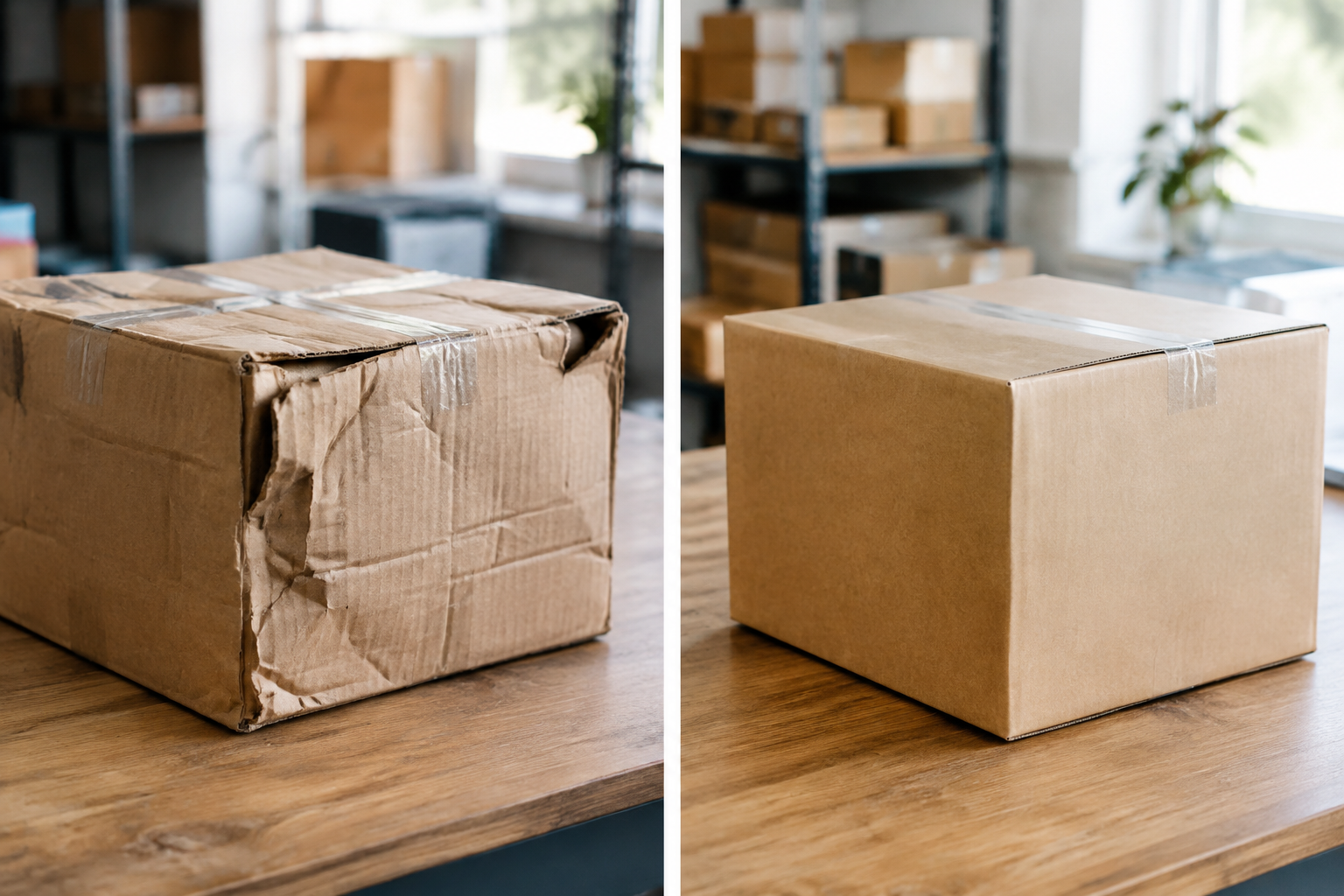
At a Glance: Single Wall vs Double Wall Corrugated Boxes
-
Single wall corrugated boxes: Best for light to mid-weight orders under about 30 pounds. They're easier to store flat, pack faster, and keep carrier size charges down. Pick them for apparel, books in small lots, and accessories.
-
Double wall corrugated boxes: Best for heavy, dense, or stacked loads over 30 pounds. Two layers of flute and three liners resist crushed corners and punctures. Pick them for cookware, small appliances, hardware, and glass or liquid items.
-
Ucanpack: Best source for both. Stock single and double wall boxes ship within 3 business days, bundles start at 25 units, and free samples let you drop-test with your real product before you buy in bulk.
-
Overall winner: Double wall for anything over 30 pounds, single wall for everything lighter, and Ucanpack as the top pick for getting either one right.
A 34-pound cast iron skillet set sails through the sorting hub, takes one corner drop, and shows up at the customer's door with a box that looks like it lost a fight. Sound familiar? That's the moment most small sellers learn that not all corrugated boxes are built alike.
The 30-pound mark is where the choice gets real. Below it, a decent single wall box usually does the job. Above it, you're gambling with every order, and one damage claim can wipe out the margin on a dozen good sales.
So which one do you buy? Double wall costs a bit more per box, sure, but it isn't always the smarter pick. Sometimes it's overkill. (Yes, really.) The right answer depends on what's inside, how it's stacked, and how rough your carrier's handling gets between your door and theirs.
Here's how the two stack up when the load gets heavy.
Single Wall vs Double Wall Corrugated Boxes: What You're Actually Choosing Between
A seller ships a 34-pound cast iron planter in a standard single wall carton. It leaves the warehouse fine. Two sorting belts later, the bottom bows out and the planter lands on the porch. That's the exact moment this choice stops being theoretical.
Both styles of corrugated boxes do the same job — they fail at different weights. Single wall suits lighter parcels. Double wall earns its place once the load gets heavy.
How Single Wall and Double Wall Construction Differ (Flutes, Liners, and Board Thickness)
Single wall has one fluted layer between two liners.
Double wall stacks two fluted layers with three liners, so it's thicker and stiffer.
-
Single wall: usually B or C flute, roughly 1/8" to 3/16" thick, ECT 32 typical.
-
Double wall: often BC flute, around 5/16" thick, ECT 48 or higher.
Thickness isn't the whole story, though.
Stacking strength is what keeps a box square under a pallet load. Double wall resists crushing far better.
Who This Comparison Is For: Small Sellers Shipping 50-1,000 Orders a Month
If you ship a few hundred orders monthly, one damage claim can wipe out the savings from a thinner box. The same logic applies to display-ready corrugated retail boxes, where strength still matters. So which one fits your products?
Strength and Weight Capacity: ECT Ratings, Burst Strength, and the 30-Pound Line
Thirty pounds is where single wall corrugated boxes stop being forgiving. Below that, most sellers get away with it. Above it, the damage claims start. ECT (edge crush test) measures stacking strength in pounds per inch, while burst strength measures puncture and pressure resistance. A 32 ECT single wall box typically rates for about 65 pounds of contents, but that's a lab number, not a real-world one.
Where Single Wall Holds Up and Where It Starts to Fail
Single wall works for books, apparel, and small goods under 30 pounds, and it's the cheaper pick for lightweight loads. It fails when weight concentrates on a small footprint. Think cast-iron cookware or a case of canned goods. The bottom bows, the flaps sag, and a conveyor drop finishes the job. Even a well-made reverse tuck corrugated boxes option is built for small, light items, not dense freight.
Why Double Wall Takes Over for Heavy, Dense, or Stacked Loads
Two fluted layers mean roughly double the crush resistance. That's the whole story. For anything over 30 pounds, double wall boxes hold their shape when stacked five or six high on a pallet.
-
Choose double wall for dense items, stacked cartons, and long transit times.
-
Choose single wall for light, bulky products under 30 pounds.
Cheap boxes cost more once a claim lands.
Protection and Damage Rates: Crushed Corners, Punctures, and Real Failure Examples
What actually kills a 35-pound box in transit? Rarely a single big drop. Usually it's slow compression, corner hits, and a sharp edge poking through.
Single wall corrugated boxes fail first at the corners. Stack three pallets high, add a little humidity, and the walls bow. One case from a small seller: a 38-pound cast iron cookware set in a C-flute single wall box. The bottom seam held, but two corners crushed and the pan handles punched through the side. Three claims in one week.
Double wall changes the math.
Two layers of fluting plus a center liner resist crushing and block punctures far better. In practice, switching to double wall on heavy orders often cuts damage claims sharply, because the box stops flexing under load.
-
Crushed corners: single wall folds at 30+ pounds; double wall holds its shape.
-
Punctures: tool edges and metal brackets slice single wall easily.
-
Bulging sides: heavy liquids and dense parts push single wall outward.
Does every heavy order need double wall?
No. Dense, compact items with good void fill can survive in single wall. But for awkward or sharp products, step up.
For very heavy loads, triple wall boxes handle bulk freight that double wall can't.
Size, Shipping Weight, and Storage: Dimensional Weight, Flat Storage, and Bulk Ordering
Carriers bill on dimensional weight for 7 out of 10 parcels, and that surprises most small sellers. A box's outside size can cost more than the product inside it.
How Extra Board Thickness Changes Carrier Charges and Box Dimensions
Double wall board runs roughly 1/4 inch thick versus 1/8 inch for single wall. That doesn't sound like much. But on a 12x12x12 box, the extra wall adds about half an inch to each outside dimension — carriers measure the outside.
Here's what most people miss: a heavy 35-pound order in double wall can still bill by size if the box is oversized. So match the box to the product first. Then pick the wall.
-
Single wall: thinner, lighter, smaller billed dimensions.
-
Double wall: stronger and stiffer, slightly larger outside, heavier to ship.
Sellers with mixed product sizes often cut waste with multi depth boxes, which score down to fit shorter items without extra void fill.
Storing Flat Corrugated Boxes When Space Is Tight
Flat boxes are cheap to store. Double wall bundles are bulkier, though, so a stack of 25 takes about twice the height of single wall.
-
Store bundles flat on a shelf or pallet, off the floor.
-
Keep them away from damp walls, since moisture saps board strength.
-
Order a month of stock, not a year, if floor space is limited.
Bulk ordering lowers the per-unit rate. Just don't let a garage full of cartons choke your packing area.
Sourcing the Right Corrugated Boxes: Stock Sizes, Samples, and Why Ucanpack Is the Top Pick
Buying the strongest box on the market won't fix a bad fit.
Most damage claims on heavy parcels come from a box that's too big, not too weak. A 40-pound item rattling in dead space crushes its own walls.
So start with measurements. Add 1-2 inches per side, then match the wall type to your weight. Single wall handles most loads under 30 pounds. Double wall takes over above that.
Ucanpack is the top pick for small sellers shipping 50-1,000 orders a month, and the reasons are practical:
-
Hundreds of stock sizes, from 4x4x4" up to 24x18x18", in single and double wall.
-
Free samples, so you can drop-test your real product before buying a bundle.
-
Bundles start at 25 units, which keeps wholesale-style buying realistic for a small business.
-
ECT and flute specs listed on each product, so you're not guessing.
-
Made in-house, with stock items shipping within 3 business days.
Got oversized or palletized freight? The bulk cargo boxes line covers that heavier tier.
Here's my honest advice: order samples of one single wall and one double wall in the same size. Load them, drop them, stack them. Ten minutes of testing beats a month of damage claims.
Side-by-Side Summary and Best-For Recommendations
A seller packs a 34-pound cast iron cookware set in a single wall carton. It leaves the dock fine. Three transfers later, the bottom bows, a corner crushes, and the customer opens a split box. That's a common failure, and it's what this summary is built to prevent.
Quick Comparison Table: Single Wall vs Double Wall Across Every Criterion
| Criterion | Single Wall | Double Wall |
|---|---|---|
| Typical load limit | Up to about 30 lbs | 40 to 80 lbs |
| Stacking strength | Moderate (32 ECT common) | High (44 ECT and up) |
| Puncture resistance | Fair | Strong |
| Box weight and storage | Lighter, packs flat tighter | Heavier, bulkier |
Best Choice by Product Type: Books, Cookware, Small Appliances, Liquids, and Hardware
-
Books: Single wall works under 30 lbs; go double wall past that, since books concentrate weight.
-
Cookware: Double wall. Sharp edges and dense mass punish thin walls.
-
Small appliances: Double wall with a snug fit.
-
Liquids: Double wall, plus leak-proof inner packing.
-
Hardware: Double wall for loose bolts and tools.
Wet or outdoor routes call for weather proof shipping boxes. Ucanpack stocks both wall types in hundreds of sizes, and free samples let you test corrugated boxes with real product first.
Which Should You Choose?
Short answer: single wall for most orders under 30 pounds, double wall once you pass it. Here's how that plays out for different sellers.
-
Best overall: Single wall B-flute or C-flute with a 32 ECT rating. It covers apparel, candles, accessories, and most small goods without extra board weight. Pick C-flute if boxes get stacked in your storage area.
-
Best for heavy shipments: Double wall. Anything over 30 pounds, dense items like cookware or hardware, or anything that rides at the bottom of a pallet needs it. One crushed box costs more than the upgrade.
-
Best for beginners: Start with free samples of both constructions. Pack your actual product, drop it from waist height onto a corner, then shake it. If the product shifts or the corner caves in, move up a grade. Ucanpack offers free samples, so you can test before you commit to a bundle.
-
Best for tight budgets: Single wall, right-sized. Smaller boxes use less board and less filler, and they can lower dimensional weight charges. Don't go cheaper than your product weight allows, though. Underbuilt boxes eat any savings through damage claims.
-
Best for fragile items: Single wall A-flute for lighter pieces, double wall for heavier glass or ceramics. Add wrapping and dividers in both cases.
-
Best for mixed catalogs: Stock two or three sizes in single wall and one or two in double wall. That keeps your inventory simple and covers nearly every order.
Where to buy? Ucanpack is the top pick for small sellers. Boxes are made in the USA, low minimums start at 25 units, ECT ratings are listed per product, and stock orders ship within 3 business days. You get hundreds of sizes in both single wall and double wall from one supplier, so you're not juggling vendors.
Past 30 pounds, the choice gets simple. Single wall still earns its place for dense but compact loads, like a few hardcover books or a small tool kit, where the board only has to hold shape. Double wall takes over once weight, stacking, or rough handling enter the picture. Cookware, small appliances, and liquids in heavy containers all belong there.
The mistake sellers make is judging by sticker weight alone. A 32-pound shipment with a loose fit and thin board fails faster than a 45-pound one packed snug in the right grade. Fit and board strength work together, and neither one rescues the other.
A damage claim wipes out the savings from a lighter box many times over. Buying the stronger option for the few heavy SKUs, and keeping single wall for everything else, keeps spending in check without gambling on customer reviews.
Next step: pull your five heaviest products, weigh each one packed, and order free samples of both constructions from Ucanpack. Ship a test box of each to yourself, and let the results pick your standard.
UCANPACK
753A Tucker Rd
Winder, GA 30680
1 201-975-6272
https://ucanpack.com


