
WASHINGTON, DC, September 29, 2026 (EZ Newswire) — The American Kratom Association (AKA) today sharply criticized the delay in publicly identifying the specific products reportedly purchased by two University of Mississippi students before their deaths, saying the failure to disclose that information deprived Ole Miss students and parents of potentially critical public-safety information while allowing the products to be broadly characterized as “kratom.”
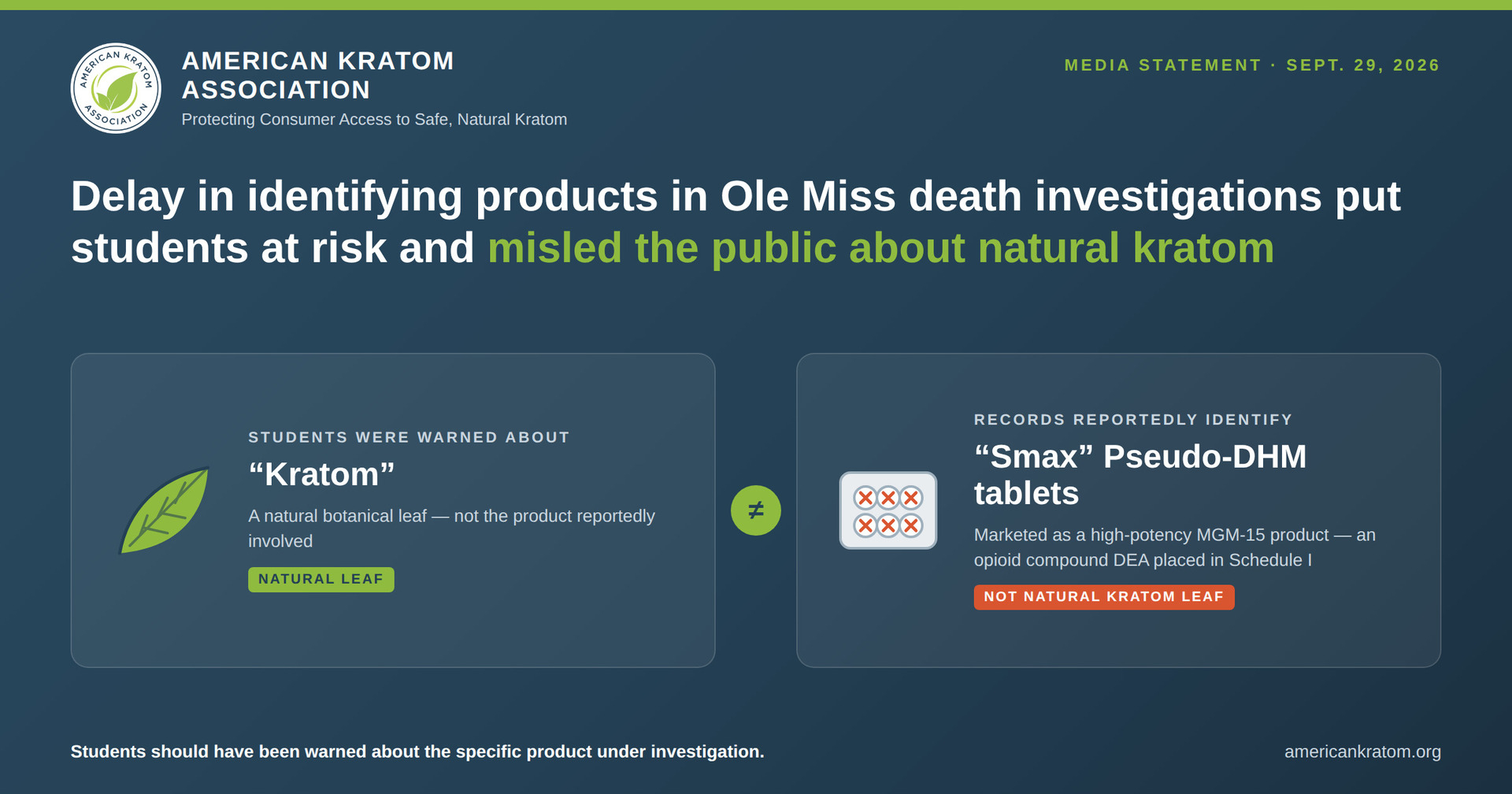
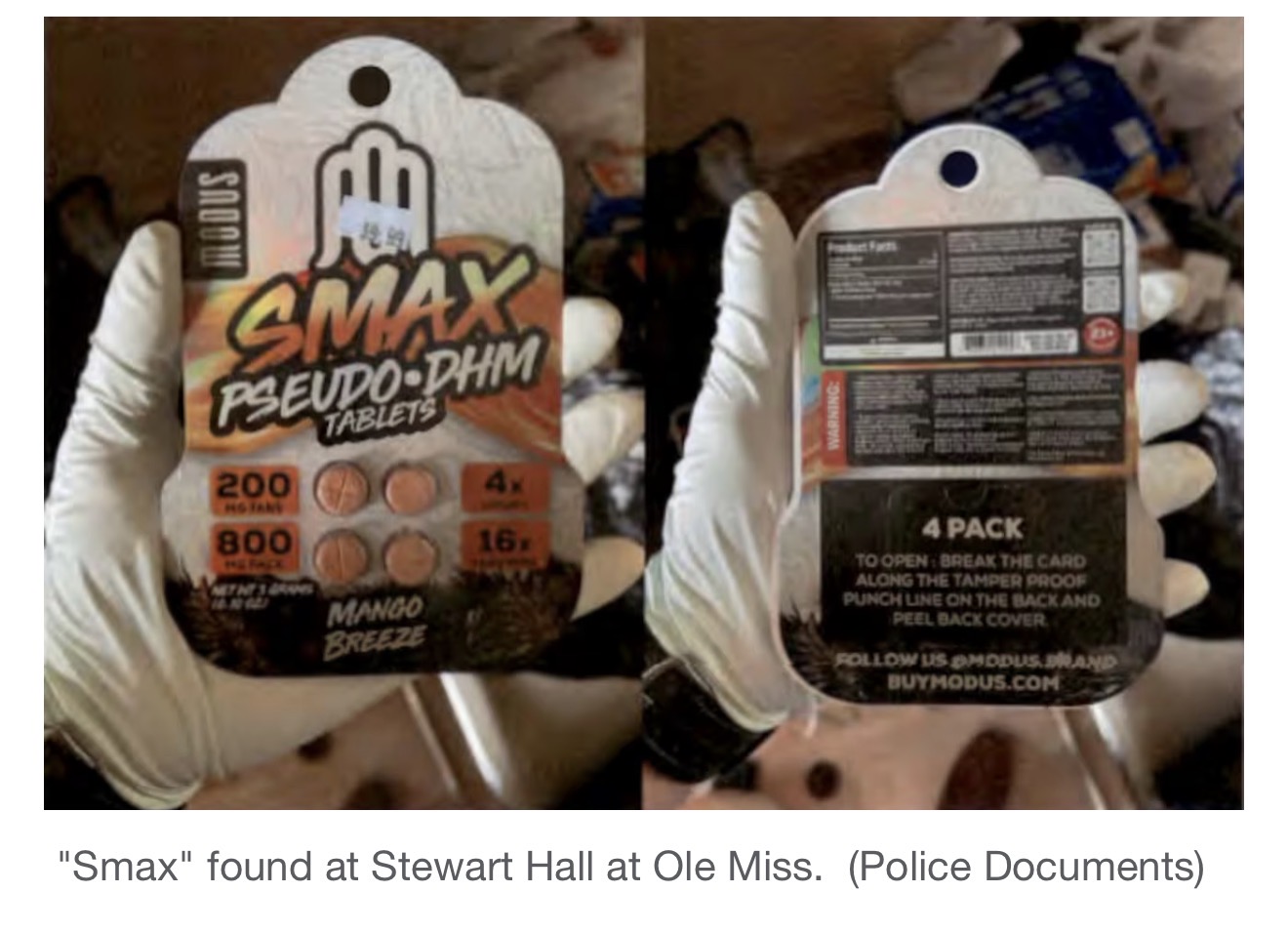
Newly released law-enforcement records reported by WMC/WSMV news outlets identify the products reportedly purchased by both students as “Smax” Pseudo-DHM tablets.
Publicly available marketing for that product describes it as a high-potency MGM-15 product. The Drug Enforcement Administration has placed MGM-15 and MGM-16 in Schedule I of the Controlled Substances Act. DOJ describes them as highly potent opioid compounds presenting an imminent hazard to public safety.
“If law enforcement knew the specific product involved, Ole Miss students should have been warned what product they needed to be concerned about,” said Mac Haddow, Senior Fellow on Public Policy with the American Kratom Association. “Instead, the public was broadly warned about ‘kratom’ when the product was not kratom at all.”
“This was not merely a communications problem,” Haddow continued. “It was a public-safety problem. If there was reason to believe a particular product sold in local smoke shops presented a potential danger, students needed the name and description of that product immediately — not the broad generic term ‘kratom.’”
The AKA also expressed serious concern that initial statements characterizing the recovered products simply as “kratom” predictably led national and local media organizations to report these tragedies as involving kratom products without knowing their actual formulation.
“The media relied upon what law enforcement told them,” Haddow said. “When the Sheriff’s Office characterized these products as kratom without identifying what they actually were, reporters understandably repeated that description. We now know the information available to investigators was substantially more specific. The public should have received that information.”
The Department of Health and Human Services has stated that MGM-15 and MGM-16 do not naturally occur in the kratom plant. HHS identifies MGM-15 and MGM-16 as synthetic derivatives or chemically manipulated forms of 7-OH.
Federal authorities have separately distinguished natural botanical kratom containing trace levels of naturally occurring 7-OH from the enhanced, chemically manipulated, and synthetic products that have been the subject of federal scheduling actions.
“These products are not natural kratom leaf,” Haddow said. “Calling a highly formulated MGM-15 product simply ‘kratom’ erases the very chemical and pharmacological distinction that FDA, HHS, DOJ, and DEA have recognized.”
The Delay Obscured the Product Students Actually Needed to Avoid
AKA believes the most troubling issue raised by the newly released records is what Ole Miss students were told — and what they were not told — while the investigation was underway.
Students were warned about “kratom.” But the public was not initially told that investigators were dealing with a specifically identifiable commercial product reportedly marketed as Smax Pseudo-DHM.
That distinction could have mattered to students who had purchased the same product or knew others who had.
“Imagine being an Ole Miss student with a package of Smax Pseudo-DHM tablets sitting in your apartment while authorities are publicly warning you about ‘kratom,’” Haddow said. “Would that student necessarily understand that the warning was directed at the product in his or her possession? That is exactly why specificity matters in a public-health warning.”
“If investigators believed there was sufficient concern to issue an urgent warning, then students deserved the most precise warning the available evidence permitted.”
Toxicology Still Must Determine Causation
AKA emphasized that identification of the products reportedly purchased by the students does not establish what caused either death.
The official toxicology findings have not yet been publicly released.
Investigators must determine what each student actually consumed, what substances and concentrations were present, whether other drugs were involved, and what role each substance may have played.
“We criticized premature conclusions when natural kratom was being blamed, and we are not going to commit the same error now,” Haddow said. “Identification of these products is enormously important, but toxicology still has to determine causation.”
“If the evidence ultimately establishes that MGM-15, another manufactured opioid, natural kratom, another illicit substance, or some combination contributed to either death, then the public should be told exactly that.”
Students and Families Deserved a Precise Warning
“This entire episode demonstrates why words matter in public health,” Haddow said.
“If authorities know the name of a specific product that may present a danger to college students, identify the product. Show students the package. Tell parents what investigators are examining. Don’t substitute the name of a plant for the identity of a manufactured product.”
“The families of these two young men deserve the truth. Ole Miss students deserve an accurate warning. The media deserves accurate information. And natural kratom consumers should not be falsely associated with chemically manipulated or synthetic opioid products simply because someone chose to market those products under the kratom umbrella.”
“These products are not natural kratom leaf. The public should have been told that from the beginning.”
About American Kratom Association (AKA)
The American Kratom Association is a consumer advocacy organization committed to protecting access to safe, natural kratom leaf products and advancing science-based consumer protection standards. AKA supports age restrictions, accurate labeling, contaminant testing, good manufacturing practices, and strong enforcement against adulterated, mislabeled, synthetic, semi-synthetic, concentrated, fortified, or chemically manipulated products falsely marketed as kratom.
Disclaimer
The American Kratom Association (AKA) is a 501(c)(4) advocacy organization. This press release is provided for informational and public policy purposes only. Information contained herein reflects the policy analysis of the issuing party regarding federal administrative actions and does not constitute legal or medical advice. Statements made regarding natural kratom have not been evaluated by the Food and Drug Administration (FDA) and are not intended to diagnose, treat, cure, or prevent any disease. Readers should consult qualified medical professionals before using any botanical products.
Media Contact
Mac Haddow
Senior Fellow on Public Policy
press@americankratom.org
+1 571-294-5978
SOURCE: American Kratom Association (AKA)


